What Radar People Detection Replaces
People counters have been installed since the 1980s. Most existing devices fall into three categories: PIR motion sensors, optical beam breakers, and ceiling-mounted cameras. Each has a known failure mode, and 60 GHz mmWave radar fixes a specific class of them.
PIR sees movement but not stationary people. It is cheap and well-understood, and it misses every person who sits down. Optical beam breakers work at choke points and fail when two people walk through together. Ceiling cameras can count and identify, but they carry GDPR risk in workplaces, retail spaces, and hospitals, and they fail when the lights go off. mmWave radar produces accurate counts with stationary occupants included, in total darkness, with no identifiable image of anybody. That is why it is increasingly the default sensor for new occupancy and people-counting products.
The Signal Processing Pipeline
The technical mechanism is well-defined and worth understanding in detail, because the engineering choices at each stage determine the eventual product performance.
Chirp transmission. The radar transmits a linear frequency-modulated chirp, typically sweeping from 60.0 to 64.0 GHz over a few tens of microseconds. The chirp is repeated as a frame, with up to 256 chirps in a single frame. The frame rate is typically 10 to 50 Hz for people-tracking applications.
Range FFT. Each received chirp is mixed with the transmitted signal, producing a beat frequency proportional to target range. An FFT across the chirp samples yields a range spectrum. The range resolution is the speed of light divided by twice the chirp bandwidth, so 4 GHz of bandwidth gives about 3.75 cm of range resolution.
Doppler FFT. Across the chirps of a frame, a second FFT yields the Doppler spectrum, which represents the radial velocity of each range bin. A walking person has a body Doppler around 1 to 2 m/s plus a wider spread of velocities from arms and legs (the micro-Doppler signature).
CFAR detection. Constant False Alarm Rate detectors isolate range-Doppler cells that exceed an adaptive noise threshold. Cell-Averaging CFAR and Ordered-Statistic CFAR are common. The detector outputs a list of detection candidates, each with range, Doppler, and signal-to-noise ratio.
Angle estimation. The 12 virtual antenna channels of a 3-TX, 4-RX MIMO array provide enough phase information to estimate azimuth (and on the IWR6843ODSEVM, elevation) angle by digital beamforming or capon. Combined with range, this gives a 2D or 3D point cloud of detections.
Clustering. DBSCAN or a similar density-based clustering groups detections into person-shaped clusters. A single person typically produces five to twenty detections per frame, depending on range and orientation.
Tracking. A Kalman filter or interacting multiple model tracker follows each cluster across frames, smoothing the position estimate, predicting future positions, and assigning identity. Track management handles new tracks (someone enters the field of view) and stale tracks (someone leaves or is occluded).
Event classification. Application logic turns tracks into events: an entry, an exit, an occupancy count, a stationary occupant, a gesture. This is where the application-specific value is built.
What 60 GHz mmWave Sees That Other Sensors Miss
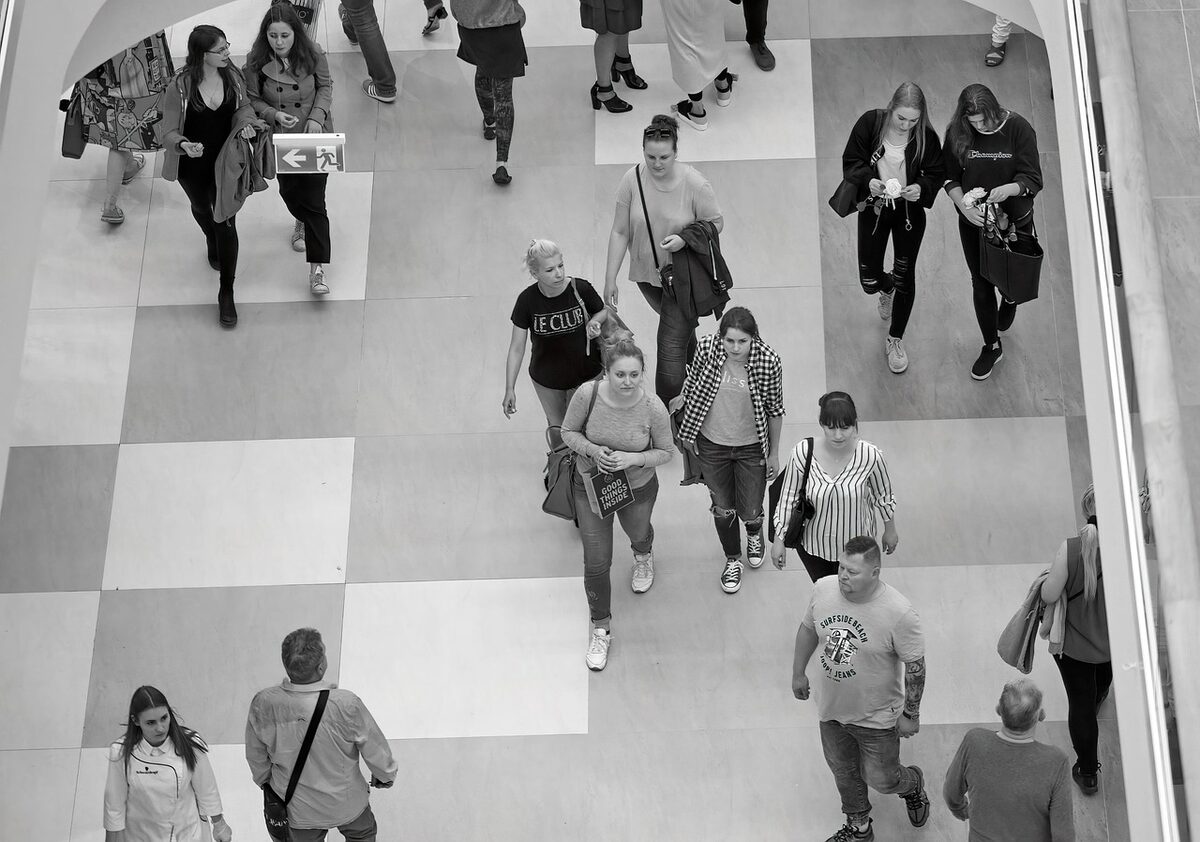
Three properties of radar at 60 GHz make it a complementary perception modality rather than a replacement for any single existing one.
- Range and velocity directly. Each detection contains both. A camera has to compute distance from monocular cues; radar measures it. A PIR sensor has neither.
- Micro-Doppler. Small motions of arms, legs, chest, and head produce a recognisable spectral signature. This is how a stationary breathing person is still detected, and how a person is distinguished from a wind-moved curtain.
- Indifference to light, dust, and minor occlusion. Radar at this wavelength penetrates fabric and thin plastic, ignores ambient light, and is not fooled by shadow.
Comparison: Radar vs Camera vs PIR vs Time-of-Flight
A pragmatic side-by-side for product owners. Numbers are typical, not absolute.
- PIR: detects warm bodies moving across the beam. Cost low, range 5 m, false-alarm-rate high, stationary detection none, privacy clean. Best for cheap presence triggers in single-occupant rooms.
- Ceiling camera: identifies and tracks. Cost mid, range room-wide, accuracy high, privacy risk significant under GDPR. Best where identification matters and privacy is solved.
- Time-of-flight (ToF) optical: precise 3D scanning. Cost mid, range 5 m, accuracy centimetre, privacy clean. Best for short-range gesture and counting in controlled environments. Fails outdoors and in bright sunlight.
- 60 GHz mmWave radar: range, velocity, presence including stationary. Cost mid (driven down by single-chip integration). Range 14 m indoor. Privacy clean. Best for occupancy, counting, and safety zones where conditions vary.
Real-World Performance Numbers
From IWR6843-based deployments we have engineered, typical numbers under representative conditions:
- Doorway entry/exit counting: above 95 percent accuracy at one entry per second; above 92 percent accuracy at two simultaneous entries per second; degrades when three or more people walk through abreast.
- In-room occupancy counting (up to 10 by 10 m): above 90 percent accuracy on stationary counts; better than 95 percent on transition counts.
- Detection range to a single standing adult: 12 to 14 metres with default chirp configuration; up to 18 metres with extended chirp at the cost of frame rate.
- Update rate: 10 to 20 Hz typical, sufficient for walking speeds. 50 Hz possible at reduced range.
- False-alarm rate from environmental motion (wind, vibration): below 0.1 per hour after tuning, in indoor environments.
Use Cases We Have Engineered
Three classes of product where mmWave radar people detection is the right answer, each with engineering specifics:
Retail and venue people counting. Doorway-mounted sensors counting entries and exits across multi-store retail and conference venues. The IWR6843 with a 120 by 120 degree pattern covers a doorway up to 5 metres wide with one sensor. Backend integration is typically over Wi-Fi or LTE-M to a cloud counter.
Security perimeter detection. Outdoor and indoor zones where presence detection triggers alarms or interlocks. Radar wins over PIR for its ability to detect creeping or stationary intruders. For high-assurance applications, pair with another diverse sensor for a 1oo2D arrangement and bring the safety case under our SIL 3 / PL e radar engineering process from the start.
Workplace and education analytics. Stationary plus transit counting across meeting rooms, classrooms, and shared offices. The radar feeds an analytics platform that informs space planning, with no individual identification at any layer of the stack.
Standards and Privacy Compliance
The right way to talk about privacy: radar in this configuration does not process personal data. Article 4 of the GDPR defines personal data as information relating to an identified or identifiable person. A range-Doppler-derived count cannot identify anybody. That said, professional installations always include a Data Protection Impact Assessment, signage at point of capture in some jurisdictions, and a clear retention policy for any aggregate data that is stored or transmitted.
For products sold across EU and US markets, radio compliance is the larger regulatory concern: CE RED with ETSI EN 305 550 for the EU, and FCC Part 15.255 for the US. Both are reachable from a well-engineered IWR6843 design. The HALready process delivers the technical file for both regions in parallel.
Integration Patterns
People-detection sensors are rarely standalone. They feed an upstream system that uses the count. The integration layer is part of the product engineering, not an afterthought:
- Wi-Fi or Ethernet for cloud-connected analytics products. MQTT or REST is the typical protocol. Add TLS, certificate provisioning, and over-the-air firmware updates.
- BLE or Matter for retrofit consumer-grade installations. Useful when the sensor is part of a wider smart-building stack.
- Modbus or OPC-UA for industrial integration with PLC and SCADA backends. Mandatory for retrofit into existing factories.
- CAN-FD for in-vehicle installations and for safety-bus integration with PLCs that demand it.
Engineering Considerations for Enterprise Product Development
Building a sellable people-detection product takes more than running the reference SDK. Five engineering decisions consistently determine product quality:
- Chirp parameters tuned to the application. A doorway counter and an in-room occupancy sensor want different range, velocity, and resolution trade-offs. Default SDK chirps are starting points, not endpoints.
- Antenna pattern matched to mounting. The 120 by 120 degree pattern of the IWR6843 is forgiving but not optimal for every geometry. Mount-position-specific simulation pays back many times its cost.
- Tracker robustness to occlusion. Two people walking together briefly look like one person. A good tracker recovers when they separate; a bad one merges identities. This is a software engineering investment.
- Edge-AI augmentation. A small machine-learning model on the radar SoC, trained on micro-Doppler signatures, dramatically improves classification of children versus adults, of carts versus pedestrians.
- Production calibration. Antenna manufacturing tolerances mean each unit has a slightly different pattern. A calibration step at end-of-line, typically two to three minutes per unit, removes the drift.
Frequently Asked Questions
How far can mmWave radar detect a person?
A 60 GHz mmWave radar based on the TI IWR6843 reliably detects a person at up to 14 metres in line of sight under typical indoor conditions. Outdoor range is shorter due to higher atmospheric attenuation at 60 GHz. The exact range depends on chirp configuration, antenna pattern, and the size of the target.
Can radar count people accurately?
Yes. Modern radar people-counting systems achieve over 95 percent accuracy on entry and exit events in a doorway, and over 90 percent accuracy on instantaneous occupancy counts in rooms up to 10 by 10 metres. Accuracy degrades when people walk closely behind each other, which is a tracking limitation rather than a sensor limitation.
Is mmWave radar GDPR compliant?
Radar does not capture images or audio. It produces point clouds and motion data that cannot identify an individual. Under GDPR, this means most radar people-counting products do not process personal data at all. Documentation should still explain what is captured, what is stored, and why, and a Data Protection Impact Assessment is good practice for any installation in a public space.
How does radar tell people apart from objects?
By motion and shape. People exhibit characteristic micro-Doppler signatures from limb movement, breathing, and small body sway. Static objects do not. The signal-processing chain uses these signatures, combined with target size and tracked motion history, to distinguish people from carts, dogs, or wind-moved decorations.
Does mmWave radar work through walls?
Through thin drywall and most fabric or wood, partially. Through brick, concrete, or metal, no. At 60 GHz the wavelength is about 5 millimetres, so the signal attenuates strongly in dense materials. This is usually a feature rather than a bug, because it means each radar covers a defined room without cross-talk with neighbouring rooms.
Discuss your people-detection product
Thirty minutes with our principal engineer. We will scope the radar architecture, mounting choices, and integration plan for your product.

Lukas Hofstätter
Founder and Managing Director, HALready GmbH
Lukas leads embedded engineering at HALready, with deep practical experience in 60 GHz radar perception, signal-processing pipelines, and the productisation of sensor-based hardware for industrial, smart-building, and medical applications.